12 Recommended Buys For Your Travels in Asia

Shopping is an important part of the traveller’s experience in Asia – it offers a window into each locale’s culture. From the small quaint collectible to the edible, from the large and functional to the downright impractical – those with a penchant for this somewhat indulgent activity will be thrilled at the options the region has to offer.

Where you choose to go determines what you end up buying. Whether in the swanky mall, museum shops, innovative retail concept shops, vintage shops, junk stores, or the local markets, you’ll be sure to not return home empty-handed.

1. BAK CHANG FIVE STONES, Singapore – A fun interpretation of Five Stones, an old local game, by taking on the design of the bak chang, a traditional Chinese dumpling. Available at the National Museum of Singapore and the Asian Civilisations Museum.

2. PANDAN CHIFFON CAKE, Singapore – Light, cottony and fragrant, these cakes made with the essence of pandan leaves are sold in bakeries around the island with Bengawan Solo being a popular choice.

3. RATTAN FURNITURE, Penang, Malaysia – Made from the stem of various climbing palms, rattan is unique for their lightweigh and sturdy structures that are weaved in a way that enhances airiness.

4. HARD ROCK MERCHANDISE, The Rock Shop, Pattaya, Penang and Bali – At this ubiquitous gift shop in the Hard Rock Hotels, you can pick up the iconic logo-emblazoned T-shirts, sweaters, mugs, collectible pins and other artist-inspired music souvenirs.

5. Royal Selangor Pewter, Malaysia – The largest pewter manufacturer and retailer in Malaysia, Royal Selangor has a variety of souvenirs made from this malleable alloy of tin and copper.

6. BALINESE WOODCARVINGS, Bali, Indonesia – Be it sculptures or furniture, these exquisite and intricately made woodcarvings will add an exotic touch to any home.

7. HEDGEHOG BRUSH, Gili Lankanfushi, Maldives – This wood-carved decorative hedgehog placed all around Gili Lankanfushi doubles up as a useful brush for sandy and dirty feet and can be purchased from the gift shop on the island.

8. BEADED SHOES AND KEBAYA, Melaka, Malaysia – Melaka is famous for their beautifully made traditional kebayas and beaded shoes. Although from different shops, no look is complete without having both the matching two-piece and footwear.

9. SILK AND OTHER FABRICS, Pattaya, Thailand – Thai silk is hand-weaved from the cocoons of silkworms, resulting in a smooth and shimmery texture that glides along your skin. Silk scarves and handkerchiefs are wildly popular among foreigners.

10. BATIK CLOTH, Bali, Indonesia – ‘Batik’ is a traditional Indonesian method of dyeing using wax and complex patterns, resulting in a delicate, ethereal design that can be woven into clothing or accessories.

11. CERAMICS, Bali, Indonesia – A well-known ceramic maker, Jenggala has a factory and retail store that offers an array of elegant ornamental ceramic products that are being used in luxury hotels and restaurants worldwide.

12. ORGANIC VEGETABLES AND HIGHLAND SWEET CORN, Cameron Highlands, Malaysia – Bring back a part of the Cameron Highlands freshness in the form of its locally grown produce, which can be bought from the many vegetable farms and markets.

Urban Farming

Urban farming has grown in popularity, especially for people who live in land-sparse cities. People have taken to growing their own organic vegetables and herbs at home, even in a high-rise apartment.

However, as edible plants are usually sun-loving, both the intensity as well as duration of sunlight received are important to achieving healthy growth.

The general rule of thumb is that edible plants should be exposed to direct sunlight for at least four to six hours a day. To tell if an area is suitable, simply look out for dark and sharp shadows—these are usually an indication of direct sunlight. Once you’ve picked the right sunny spot, the chances of your little organic farm taking off would be much higher.

Urband Farming

Getting Started

  1. Do take care to choose easy-to-grow edibles when you’re starting out so that you won’t get discouraged too soon.
  2. Quite a number of the vegetables and herbs grown can be successfully started from seed in pots. Salad greens such as rocket, mizuna, mibuna and mustard greens are relatively fuss-free. These offer a variety of tastes, from spicy to mild.
  3. Sweet basil is commonly found in many home herb gardens, and it’s not hard to see why—fresh basil smells great, and can be used in a variety of dishes. While most herbs prefer dry, well-drained soil, basil prefers to be kept moist (though not waterlogged).
  4. Compost is easily available these days, so you can purchase some if you don’t have the space or time to make your own. By combining loam, compost and coarse sand in equal parts, you’ll get a soil mix that provides nutrients, retains moisture and improves drainage. Plant your seeds according to the instructions on the seed pack, and water thoroughly.
  5. Vegetables should be fed with organic fertiliser every few weeks, and herbs a little less often. You can also create a natural pest repellent with a garlic-infused concoction to be sprayed on your plants.

Urban Farming 2

DIY: Grow Your Own Bean Sprouts at Home

Method:

  1. Choose a small bean or seed. Almost any kind of beans can sprout. Mung beans are a popular choice easy available   from markets. Dried beans are better than fresh beans as they are unlikely to go bad.
  2. Prepare and clean a container. Depending on the amount of beans, anything from a glass jar to a barrel will work.
  3. Wash bean sprouts with running water, similar to washing rice.
  4. Fill one-fifth of the container with beans, as it might be difficult to monitor the growth of too many beans.
  5. Pour water (room temperature) over the beans. Fill the container to the brim and cover it with a mesh lid or cotton cloth, secured with a rubber band. This allows just enough air to prevent mould from destroying the beans. Soak the beans for 8 to 10 hours in a shaded environment.
  6. Drain off the water through the cloth. Open the container and pour cold water over the beans. Shake the container. Reseal the container and drain the water again. Repeat this step 2 to 3 times a day to keep the beans clean and moist.
  7. Note the date and observe the sprouts grow. Beans take around five days to sprout.
  8. Harvest beans when they reach between one to three inches in length. Rinse, drain and allow the sprouts to dry on a clean paper towel for eight hours, till excess water evaporates.

Growing your own greens may take a little work, but will prove to be an extremely fulfilling experience. Especially when it’s time to harvest some fresh produce from your windowsill or balcony.

Chinese New Year – Simple Reunion Dish

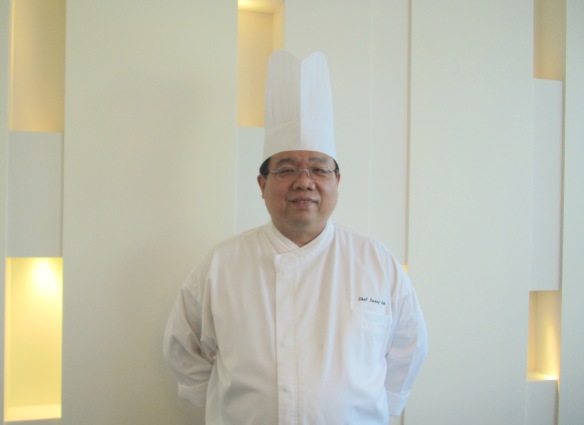
Concorde Hotel Singapore Chef Sunny

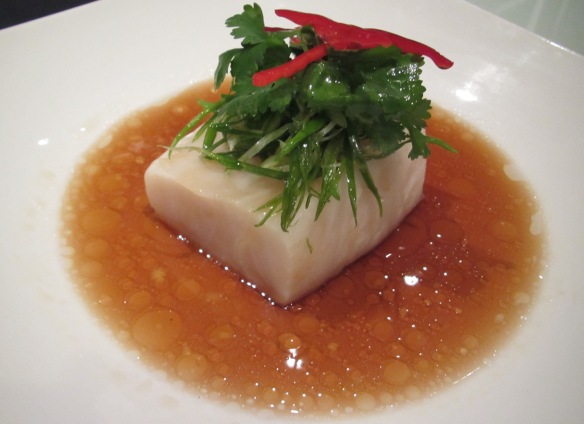
Chinese New Year is the time of the year for family gatherings and a time of feasting with loved ones. If you are thinking of a simple and delicious dish for the reunion dinner, you may like “Steamed Cod Fish with Superior Soya Sauce”. Chef Sunny from Concorde Hotel Singapore shares his recipe.

Ingredients

  • 130g Codfish Fillet
  • 10g Spring Onion
  • 10g Chinese Parsley
  • 2tbs Peanut Oil (Make it hot first)
  • 1 Chili

Sauce

  • 5g Spring Onion
  • 5g Chinese Parsley
  • 10g Ginger
  • 2tbs Sugar
  • 3tbs Soy sauce
  • 1tbs Chicken powder
  • 50ml Water

Steamed Cod

Method:

  1. Slice spring onion, Chinese parsley and chili to long thin stripes, similar to matchsticks.
  2. Slice ginger.
  3. Mix soy sauce, chicken powder, sugar, spring onion, ginger slice and Chinese parsley in a small pot.
  4. Add 50ml of water to the pot of mixture and bring it to boil for 3-5 minutes. Taste the sauce.
  5. Steam the cod fish fillet for about 6 minutes until cooked.
  6. Top the fish with spring onion and pour the hot peanut oil over.
  7. Pour the pot of sauce over the fish.
  8. Garnish with Chinese parsley and chili and the dish is ready to be served.

The Elder Statesman of Nyonya Cuisine

How Baba Jolly, Singapore’s homemade chef, spiced up the kitchen and brought customers flocking back to Concorde Hotel Singapore.

In this Wee family circle, the celebratory refrain at gatherings is instead sung, “For Jolly’s a good fellow.” For patriarch Mr Jolly Wee, better known far and wide as Baba Jolly, is indeed a jolly good fellow. Despite a strict upbringing by his elders, several generations of Peranakan (Straits Chinese) from the  Riau islands.

The Peranakan (“locally-born” in Malay) Chinese date from the 14th to 19th Century, and are descendants of Chinese traders who settled in Melaka, and lured by commerce, ventured to Penang and Singapore, where they developed their communities, also known as “Straits-born”. Members of this community are addressed as Baba (men) and Nyonya (women).

Many were English-educated and considered “elites”, with an affinity for the British (than China). Through intermarriage (with Indonesian and Malay) and trading, the Baba and the Nyonya were fluent in English and Malay, hardly speaking any Chinese. And you were of course expected to make liaisons with your own kind. So Babas married Nyonyas (or incur the wrath of the clan).

Baba Jolly, 88, had his head turned by a girl on a bicycle along Joo Chiat Road some 70 years ago. “My friends were in this toddy shop in Joo Chiat Road. Violet (the girl on bicycle) worked in the office where you went to collect your ration of rice. One day she asked to borrow my camera. From there, we started cycling in the kampung (village), buy koay teow (flat rice noodle), got to know each other better.”

To hear Baba Jolly recount his early years is to take a stroll through a Singapore redolent of village life where everybody knows your name (and your father’s business). But it was not all manis (sweet). “Her father hated me, and my father didn’t like her.” Violet was a Hakka Chinese. “But we were both strong in our love. In fact, I saw her father beat her. So I planned a way out. I was very daring. Secretly we packed our things, and helped by a Malay family, we lived in a room in Dickson Road. Half the size of a room in today’s HDB flat.”

Baba Jolly2

When Baba Jolly and Violet brought their first-born Sylvia to show to the Wee grandparents, tears were shed, forgiveness was begged, a party was thrown. Naturally, a tok panjang (long table, laden with food) ensued. Five sons followed big sister Sylvia. Baba Jolly’s long association with good food stems from his primary school days. “After school, I would sell kueh (variety of local pastries) for my mother which she made from leftovers, kueh chara, popiah goreng. She would give me two cents as reward. I enjoyed following my mother to the market, in char kiaks (clogs) and bakul (basket), helping her in the kitchen.

For Chinese New Year she would make blandah and bangkit (biscuits) and we would have a big feast, a chicken. My mother could not bear to slaughter the live chicken, so  I learned to do it, from watching the seller in the market. From here on I learned to do things correctly. So I am very strict about doing things the right way.” Two of his children, Sylvia and youngest son Mervin, confirmed that their parents raised them right from being strict and to a rigid code of conduct. “Not like today’s children,” said Sylvia, who is rather relaxed with her children and grandchildren. “We didn’t say much in those days. Parents did all the talking. And deciding.” Even friends are not spared this “correctness”.

When a friend mused about her fancy for running a nonya food outlet, Baba Jolly sat her down and took her through the paces of getting it all right. From helping her scout a location, interior decor, to offering free morsels, to setting up a corner selling Peranakan arts and crafts. It was tough going, or, as Baba Jolly put it, when he found her crying, “If uncle don’t teach you properly now, next time you suffer.”

Today of course the said lady operates her cafe and catering business, to great success. His own great success has seen Baba Jolly notch some 20 cafeterias under his sarong belt. Said Mervin, “Oh my father ran cafeterias for companies, like Caltex, Esso, Fairchild, Mobil, Texas Instruments, all.” The jewel in the crown for Baba Jolly was breathing new life into Spices Cafe at Concorde Hotel Singapore. “The restaurant was rather quiet,” Baba Jolly described his first visit. He’d been tasked to reposition the restaurant with a nonya menu. Singapore’s elder statesman of Peranakan cuisine had already been invited abroad, a few times over, to “ambassador” the culture and food of this colourful community. It was a task he loved and relished.

To hear Baba Jolly tell it, there is no mystery surrounding Peranakan dishes. “You have to know your spices, how to cook it, and there you have it, no magic.” He is modest, about his sleight of hand, in the kitchen. “From my mother’s time, we had no measure, we simply used our hand. If you pick up some onions in the palm of your hand you will find it is about 120 grams.” A cubit (pinch) of this, an agak-agak (approximation) of that, a nose for when the tumis (stirfry) is done, an eye for presentation, and the final taste test, is Baba Jolly’s nonya cooking creed.

A stickler for getting it perfect, he toiled in Concorde’s kitchen till the cooks got it right. No rempah (spices paste) escaped his steely-eyed supervision. “I’m strict. You don’t follow me, don’t waste my time. You get it wrong, I show you how to rectify.” And the crowds came, especially Bibiks (aunties) and Babas, arguably the toughest palates to please. They left grinning. The dishes were spot-on, having passed the taste-test of the Peranakan community at large.

Baba Jolly’s wife Violet passed away two years ago, after 65 years of marriage. He has 11 grandchildren and two great-grandchildren. His parents’ family grew up in East Coast Singapore, where his father worked in the post office, his mother brought up six children.

“When she was free, she would play cherki (card game). I too followed in her footsteps, when I had my own family, I sell food I made, mee siam (fried vermicelli) from a pushcart in St Michael’s estate, before running canteens. But I always cook the family meal.” Sylvia recalled, “My mother would be playing mahjong, and my father would call her to come home and eat.”

The senior Mrs Wee was a mean cook herself, but deferred to her hubby in the kitchen. All their children and in-laws have learned to cook. Well, there’s always Baba Jolly’s cookbook and family recipes (Sylvia is the guardian) but these years, like most families, they eat out over Chinese New Year. “So many tables lah, you know, our families. The Peranakan baju (clothing) of sarong kebaya, baju lok chuan (long shirt) is not so much sported except for occasions calling for the traditional dress code. Many have married ‘out’ to non-Peranakan as the culture has shifted. Some superstitions persist. You swallow your noodles, not bite them because that would be to ‘cut short your life’. And when you accidentally choke on a bone, swallow a ball of rice, spin your plate round three times, chanting ‘kucing, kucing, kucing’  (cat, cat, cat).”

However, the community’s fame for its “lau juak” (knowing how to enjoy life) thrives. Its love of song and dance and drama, and even a good old gossip. And ultimately food. Nonya cuisine, Peranakan dishes. Baba Jolly continues to give cooking lessons. (As far-flung as Abu Dhabi, Bali, Hannover.) He even taught a boy who had decided on a hair-stylist career to open a Straits Chinese cafe in San Francisco! A word to the wise, before embarking on a food and beverage career, “Study the environment. Take risks. Dare to change.

Kepetin Bakwan Recipe

35 min preparation time | 8 serving | 5 min cooking time

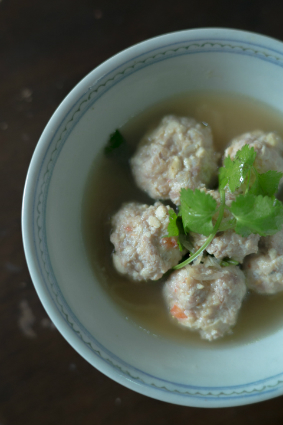
This pork and crab meatball soup is a must-have dish in many Peranakan households during Chinese New Year. Traditionally, the Nyonya served this dish on special occasions as crab meat was costly and the recipe is laborious if one follows the traditional method of using live crabs, which have to be steamed before the flesh is removed by hand to ensure there are no odd bits of shell.
Kepitian Bakwan, Recipe provided by: Baba Jolly Wee

Ingredients

  • 300g Minced pork 200g Fresh prawns, shelled and deveined, coarsely chopped 100g Crab meat
  • 1 Large tau kwa (firmed bean curd), smashed 300g Fresh turnip, Shredded 300ml Stock from chicken bones 900ml Water
  • 3 Cloves garlic, minced
  • 2 Tablespoon tau jio (fermented bean paste)
  • 1/4 Tablespoon chicken seasoning powder
  • Pinch of white pepper
  • 1 Tablespoon soy sauce
  • 2 Tablespoon cooking oil
  • Tablespoon cooking oil

Method

For crab meat ball

  1. In a medium bowl, mix together the minced pork, crab meat and chopped prawns; add smashed tau kwa, lightly season with soy sauce.
  2. Mix all the ingredients until completely incorporated and the mixture becomes sticky.
  3. Form into small, bite-size meatballs and set aside.

For soup

  1. Heat oil in a Chinese wok or soup pot, add minced garlic and tau jio, fry till fragrant.
  2. Add stock, water, white pepper and chicken seasoning powder, bring to boil and add shredded turnip.
  3. When boiling, gently drop the crab meat balls and bring to boil over high heat. Switch to low heat and allow to simmer till crab meat balls are properly cooked, about 5 – 8 min.
  4. Garnish with coriander leaves and serve with rice.